
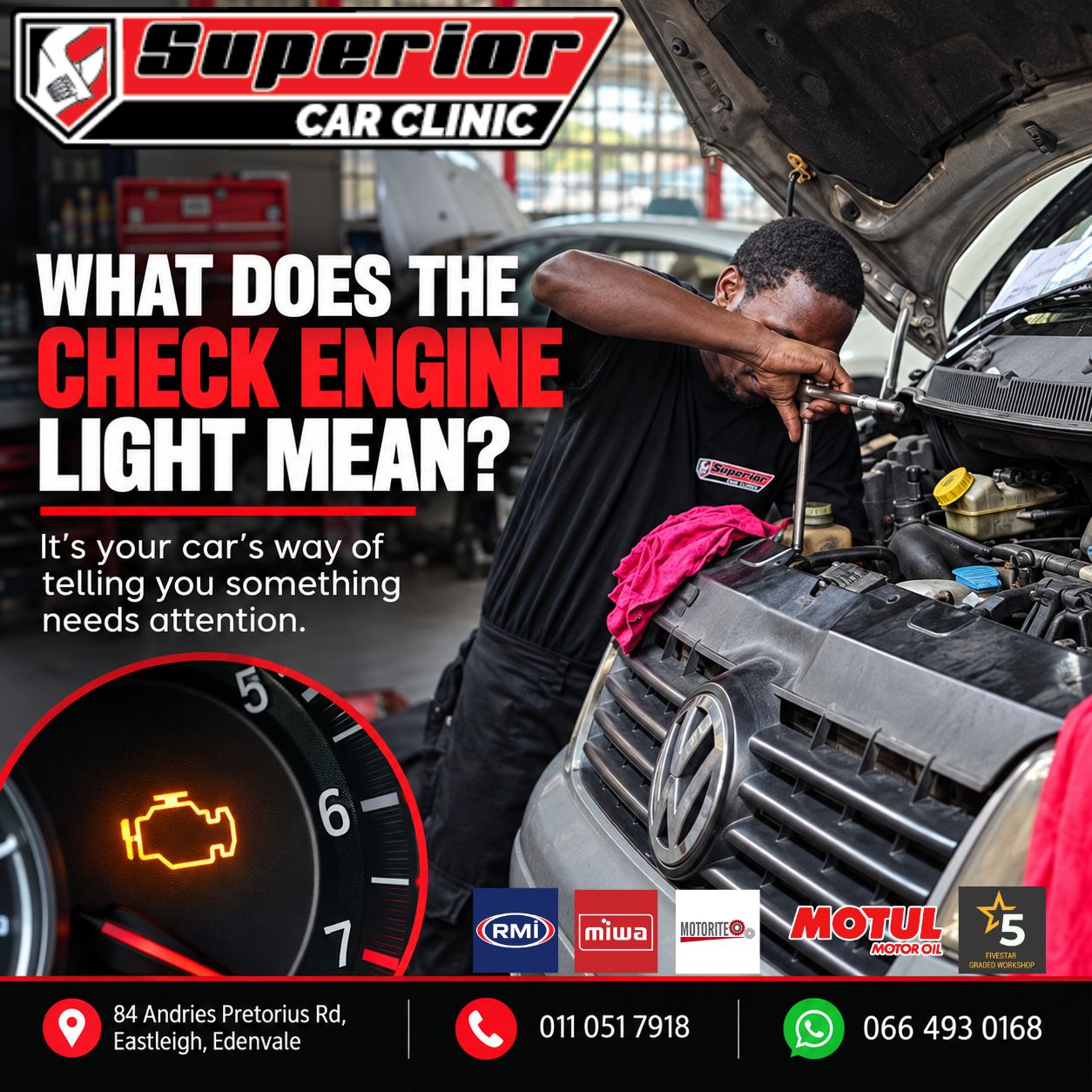
Seeing the check engine light appear on your dashboard can be worrying, especially if you are not sure what it means or whether it is safe to keep driving.
The good news is that a check engine light does not always mean there is a major problem with your engine. It is your vehicle’s way of telling you that its onboard computer has detected something that needs attention.
The cause could be something relatively simple, or it could indicate a more serious issue that requires professional diagnosis.
In this guide, we explain what the check engine light means, what causes it to come on, whether you can continue driving, and what you should do when it appears.
What is the check engine light?
The check engine light is part of your vehicle’s onboard diagnostic system. It is sometimes referred to as the engine warning light or malfunction indicator lamp (MIL).
When your vehicle detects a fault with a system that could affect the engine, emissions, fuel efficiency or vehicle operation, the onboard computer can switch on the warning light.
The light is usually displayed as an amber or yellow engine-shaped symbol on the dashboard.
Importantly, the check engine light can indicate many different problems. The light itself does not tell you exactly what has gone wrong. A diagnostic scan is generally needed to identify the fault code and determine the underlying cause.
What does the check engine light mean?
A check engine light means that your vehicle’s computer has detected a fault and stored a diagnostic trouble code (DTC).
Some common causes include:
- A faulty oxygen sensor
- A damaged or failing catalytic converter
- Problems with the ignition system
- Worn or faulty spark plugs
- A failing ignition coil
- Fuel system problems
- Air intake or airflow sensor problems
- An emissions-system fault
- An EVAP system leak
- A loose or damaged fuel cap
- Problems with the engine’s sensors
- Issues with the vehicle’s exhaust system
Because there are so many possible causes, it is not possible to accurately diagnose the problem simply by looking at the warning light.
What is the difference between a steady and flashing check engine light?
One of the most important things to look at is whether the check engine light is steady or flashing.
A steady check engine light
A continuously illuminated check engine light generally means that the vehicle has detected a fault that should be investigated.
If the car is driving normally and there are no other warning signs, you may be able to drive it carefully to a suitable workshop for diagnosis. However, it is best not to ignore the warning, particularly if the light remains on.
Continuing to drive with an unresolved fault can sometimes lead to more expensive repairs or additional damage.
A flashing check engine light
A flashing check engine light can indicate a more serious fault.
For example, a severe engine misfire can cause unburned fuel to enter the exhaust system, potentially damaging the catalytic converter.
If the check engine light is flashing, especially if the vehicle is shaking, losing power, running roughly or producing unusual noises or smells, you should reduce the load on the engine and have the vehicle assessed as soon as it is safe to do so.
Can I drive with the check engine light on?
Whether you can safely continue driving depends on why the light has come on and how the vehicle is behaving.
If the light is steady and the vehicle appears to be operating normally, it may be possible to drive a short distance to a workshop for a diagnostic check.
However, you should take greater care if you notice other symptoms, such as:
- Loss of engine power
- Rough running or misfiring
- Unusual noises
- Excessive smoke
- Unusual smells
- Poor acceleration
- Excessive fuel consumption
- Overheating
- Additional warning lights
If the check engine light is flashing or the vehicle is behaving abnormally, continuing to drive could make the problem worse. Stop driving when it is safe to do so and seek professional assistance.
What should I do when the check engine light comes on?
Don’t panic, but don’t ignore it either.
Here are some sensible steps to take:
1. Check whether the light is steady or flashing
This is one of the first things to establish. A flashing light can indicate a more urgent problem than a steady light.
2. Pay attention to how your car is driving
Notice whether the vehicle is running normally or whether you can feel a difference.
Is the engine shaking? Has the vehicle lost power? Is it struggling to accelerate? Are there unusual smells or noises?
These symptoms can provide useful information for a technician.
3. Check your fuel cap
On some vehicles, a loose, damaged or incorrectly fitted fuel cap can trigger the check engine light.
Make sure the fuel cap is properly tightened. If the warning light remains on, the vehicle should still be diagnosed rather than assuming the fuel cap was the cause.
4. Don’t simply clear the warning light
A diagnostic scan can reveal the fault code that caused the warning light to appear.
Clearing the code without identifying and repairing the underlying problem may only temporarily switch the warning light off.
5. Have the vehicle professionally diagnosed
A proper diagnostic check can help identify the system responsible for the warning and determine what needs to be repaired.
Why does my check engine light keep coming on?
If the check engine light repeatedly comes back after being cleared, there is likely an underlying issue that has not been properly resolved.
Simply resetting the light does not repair the fault.
A technician can use diagnostic equipment to read the stored fault codes and carry out further testing to establish why the fault is occurring.
Does a check engine light always mean an expensive repair?
No. A check engine light can be triggered by a relatively minor issue, but it can also indicate a more significant mechanical or emissions-related problem.
The cost depends entirely on the underlying cause.
For example, a problem with a sensor or fuel-system component may require a very different repair from an issue affecting the catalytic converter or another major engine component.
This is why getting the vehicle properly diagnosed is important before assuming the worst.
Can a diagnostic scan tell me exactly what is wrong?
A diagnostic scan can retrieve fault codes stored by the vehicle’s computer. These codes can provide valuable information about the system or component where a problem has been detected.
However, a fault code does not always mean that the named component itself has failed.
For example, a sensor-related fault code may be caused by the sensor, its wiring, another component, or an underlying problem that is affecting the sensor’s readings.
A professional diagnosis therefore involves more than simply reading and replacing the component named by a fault code.
Why shouldn’t I ignore the check engine light?
It can be tempting to ignore a warning light if the car still seems to drive normally.
However, some vehicle problems may initially have few noticeable symptoms. Continuing to drive with an unresolved fault could allow the problem to develop or cause damage to other components.
Getting the vehicle checked early can help identify the problem before it becomes more serious.
Check engine light FAQs
What does a yellow check engine light mean?
A yellow or amber engine-shaped warning light generally indicates that the vehicle’s onboard diagnostic system has detected a fault. The cause can range from a relatively minor issue to a problem requiring urgent attention.
What does a flashing check engine light mean?
A flashing check engine light can indicate a serious fault, such as an engine misfire, which may cause further damage if the vehicle continues to be driven. Have the vehicle assessed as soon as it is safe to do so.
Can a bad spark plug cause a check engine light?
Yes. A faulty or worn spark plug can contribute to an engine misfire, which may cause the check engine light to illuminate.
Can low oil cause the check engine light to come on?
Low engine oil can cause warning lights to appear, although the exact warning depends on the vehicle and its systems. If an oil warning light appears, follow the vehicle manufacturer’s instructions and check the oil level as appropriate. Do not assume that an engine-shaped check engine light specifically means low oil.
How do I turn off the check engine light?
The correct way to turn off a check engine light is to identify and repair the underlying problem. Once the fault has been properly addressed, the warning may switch off automatically or can be cleared using appropriate diagnostic equipment.
How long can I drive with the check engine light on?
There is no universal time or distance that is safe for every vehicle. It depends on the fault that triggered the warning and the condition of the vehicle. A steady light with no other symptoms may allow you to drive carefully to a workshop, while a flashing light or serious symptoms require more immediate attention.
Get your check engine light diagnosed
A check engine light should not automatically be a reason to panic, but it should not be ignored either.
The warning tells you that your vehicle has detected a problem, but proper diagnostic testing is needed to determine what is actually causing it.
If your check engine light has appeared, getting the vehicle checked promptly can help identify the problem and prevent a potentially minor issue from becoming a more expensive repair.
Need help diagnosing your check engine light? Contact Superior Car Clinic to arrange a diagnostic check or speak to our team about your vehicle.


